

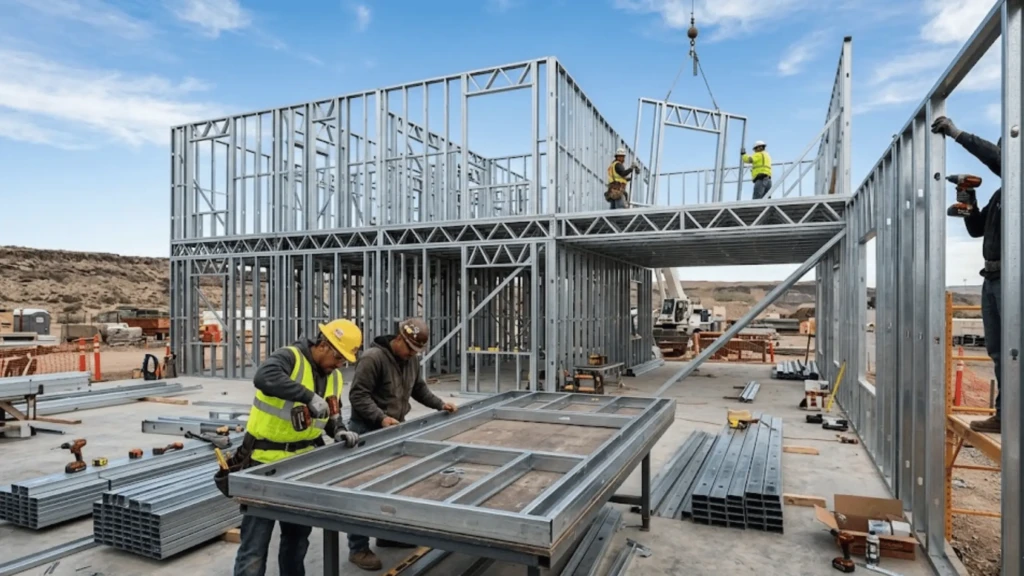
When you walk past any construction site in Dubai, Abu Dhabi, or Sharjah, you would notice that the skeleton going up isn’t made of concrete blocks, but steel. It’s steel, thin and cold-formed, assembled with perfect accuracy.
Previously, we explored myths about light-gauge steel and compared light-gauge steel with traditional construction to understand how it stands out in modern building practices. Today, we’re focusing on a more practical question: how are light-gauge steel buildings actually made?
Light-gauge steel structures are changing the construction sector of the UAE. From villas to the modular labour camps, everything is now made with light-gauge steel. So, how are the light-gauge steel structures manufactured? Let us walk you step by step.
Steps in Light-Gauge Steel Fabrication
So, how are light-gauge steel buildings made? Each stage contributes to the strength and versatility of light-gauge steel applications.
1. Where It All Starts: The Steel Coil
A coil of cold-formed steel strip is the first thing that goes into making a light-gauge steel structure. The coil is thin, flat, and wound like a big roll of tape. Depending on what the steel will become, such as a wall stud, a roof truss, a floor joist, or a load-bearing panel, these coils are usually between 0.55 mm and 2.5 mm thick.
In the UAE’s coastal climate, galvanising is a must. Most coils come with a layer of zinc or a mix of zinc and aluminium already on them to protect them from salt air and humidity.
Before they start cutting or shaping, responsible light-gauge steel manufacturers check a number of things that come in:
- Testing for tensile strength: Does the steel meet the grade?
- Checks for coating adhesion: Will the galvanising really stay put under stress?
- Checking the dimensions: are the thickness and width within acceptable limits?
These checks seem like something that should be done all the time, but that’s when lower-quality operations cut corners. Always ask your supplier for mill certificates. If they hesitate, it means something.
2. Roll Forming: Where the Shape Is Born
This is the most important step in building a light-gauge steel system, and it’s worth knowing even if you only know the basics.
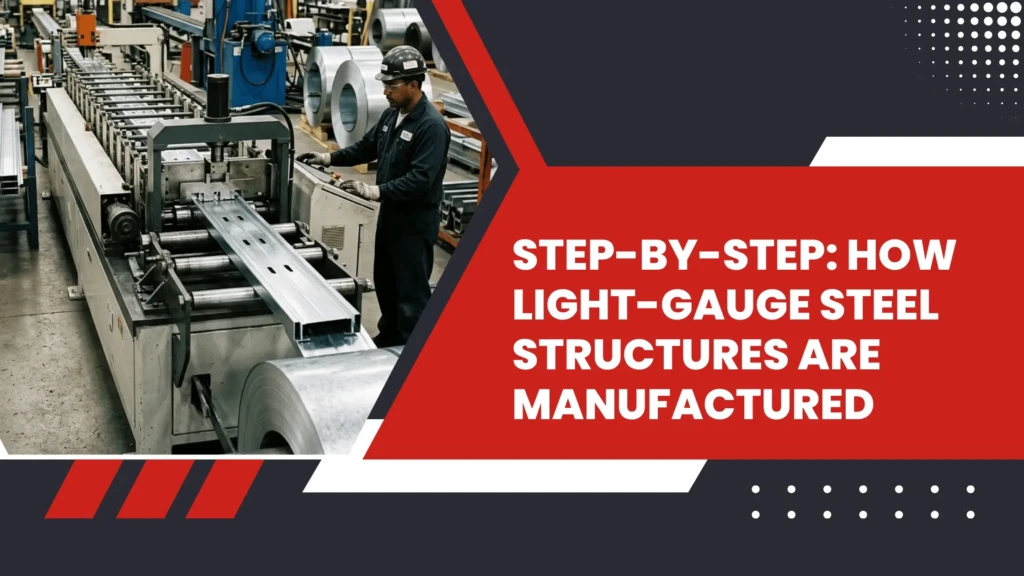
A machine with a long line of roller dies, sometimes 20 or more in a row, pulls the flat steel strip through. The metal is bent a little more at each station until the finished cross-section profile appears at the other end. Some common profiles are:
- C-sections are used for wall studs and floor joists.
- U-channels are used as tracks at the top and bottom of walls.
- Z-sections are used for roof purlins.
There is no heat. That’s why it’s called cold-forming by the modular steel building manufacturer in the UAE: the process is completely mechanical.
3. Punching, Notching, and Pre-Cutting
After the sections are done on the roll-forming line, they head over to the punching and notching stations. This is the part where the light-gauge steel manufacturers get them ready for installation out in the field.
- They punch service holes at specific intervals for things like electrical conduit, plumbing, and HVAC ducting.
- The workers cut notches at the ends where the sections are going to overlap or intersect.
- For longer spans, we add web stiffeners to prevent any local buckling.
And all this is powered by CNC programming – basically, the engineering drawings turn straight into instructions for the machines.
4. Panel and Frame Assembly
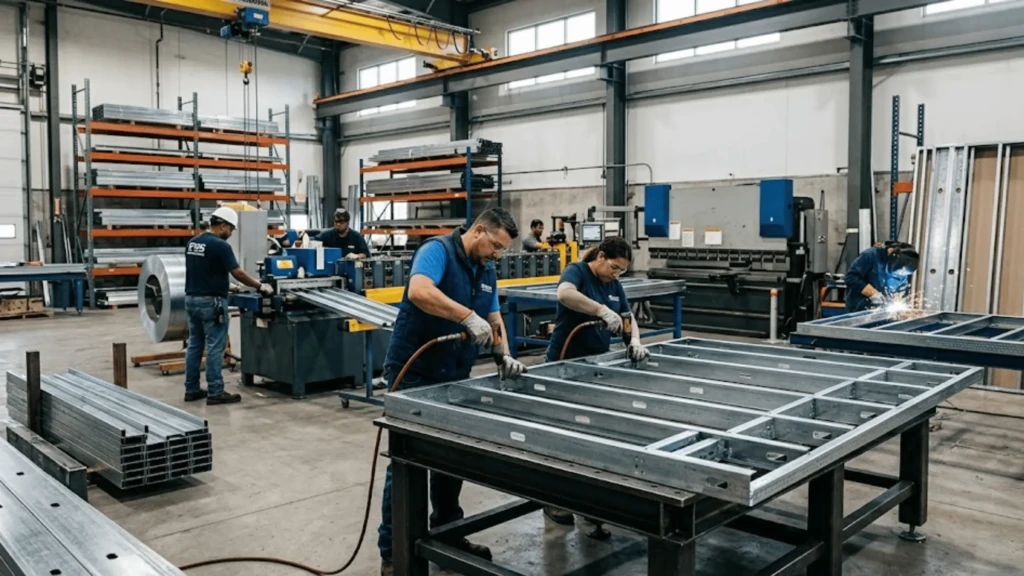
The cut and punched pieces are assembled into complete wall panels, floor cassettes, or roof trusses on flat steel jigs that keep everything square as they’re fastened.
They use automated or semi-automated tools to drive the screws, which follow CNC-generated assembly sheets.
Here are the usual dimensions for the panels by steel structure companies in the UAE:
- Wall Panels: between 1.2 m and 3.6 m wide
- Floor Cassettes: can span up to 6 m or even more
- Roof Trusses: these are assembled in sections for bigger spans and then bolted together on site.
Before leaving the assembly area, every panel is labeled and numbered.
5. Surface Treatment and Final Inspection
Before anything is shipped out, we perform a final quality check on all panels and frames. This inspection usually looks at a few key things:
- Dimensional Accuracy: Are the sections straight, and do the connections fit well?
- Coating Integrity: Is the galvanizing intact, or does any area need a little touch-up with cold zinc spray?
- Labelling and Sequencing: Does every component match what’s shown in the site assembly drawings?
This is where the differences between light-gauge steel and hot-rolled steel really show. Hot-rolled sections are often painted or primed after they’ve been cut and welded on site, which can lead to a lot of inconsistencies due to outdoor conditions.
On the other hand, cold-formed panels leave the factory already protected, inspected, and totally ready for installation.
6. Packaging and Delivery
The last step before a truck heads out from the factory is all about packaging and logistics planning. It may not get a lot of attention, but it’s really important:
- Panels are organized in the order they’ll be installed – the ones that go on-site first get loaded last.
- We use protective wrapping to avoid scratches and damage to the coating during transport.
- Every bundle is labeled clearly to match the site drawings.
In the UAE, where projects can include remote industrial sites, tight urban areas, or staged construction schedules, getting this sequencing right can make a huge difference. It could turn a two-week installation plan into a five-week one.
The steps in the light-gauge steel structure manufacturing process are all interconnected, and the final link is ensuring the right panel arrives at the right spot on time.
Conclusion
Light-gauge steel construction is a precise, efficient process that transforms simple steel coils into high-performance structural systems. Each stage, from roll forming to final delivery, ensures accuracy, durability, and speed on site.
The cost efficiency of light-gauge solutions makes them ideal for modern UAE projects, reducing waste, labour time, and overall expenses. Alongside this, light-gauge steel structure benefits include strength, corrosion resistance, and design flexibility.
Companies like Emirates Portacabin are leading this shift by delivering reliable, factory-engineered solutions tailored to regional needs.
As demand grows, light-gauge steel continues to redefine how smarter, faster, and more sustainable buildings are constructed.
FAQs
How are light-gauge steel buildings made?
Light-gauge steel buildings are made by roll forming steel coils into structural sections, followed by CNC punching and assembly. These prefabricated components are then transported and installed on-site efficiently.
What are the benefits of light-gauge steel structures?
Light-gauge steel structures offer durability, corrosion resistance, and faster construction timelines. They also reduce material waste and provide design flexibility for modern building requirements.
Is light-gauge steel construction cost-effective?
Yes, light-gauge steel construction is cost-effective due to reduced labour, faster project completion, and minimal waste. It also lowers long-term maintenance costs compared to traditional construction methods.