

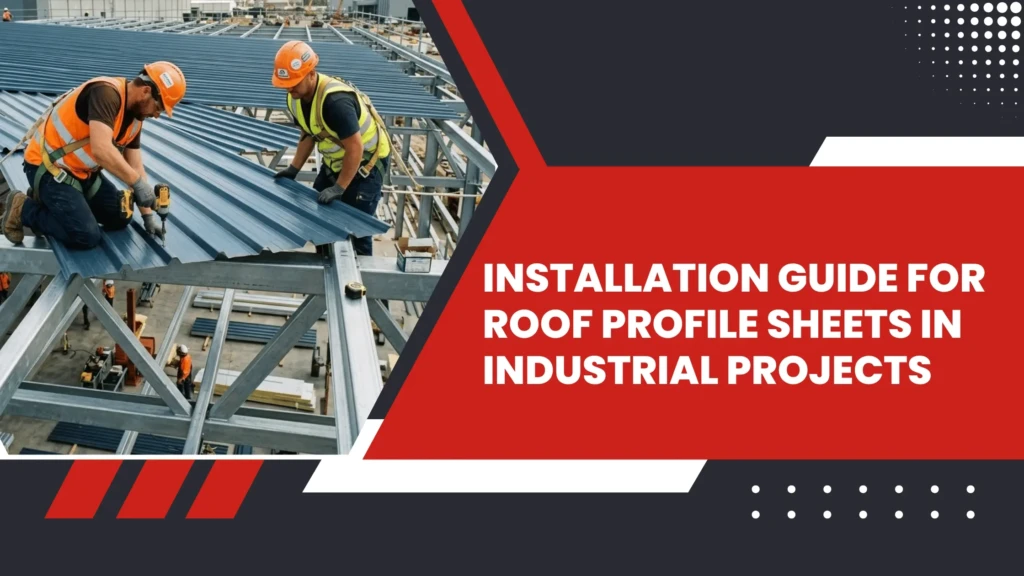
Industrial construction requires more reliable materials, and each step of the process must be perfect for a lasting impact. So, when you are considering installing roof profile sheets for industrial buildings, you must understand safety, structural requirements, and environmental standards.
Previously, we compared roof profile sheets with traditional roofing and explored the role of roof sheets in energy efficiency. Today, we will walk you through an essential topic for modern construction projects, an installation guide for roof profile sheets in industrial projects.
We will figure out what steps will suit you best before you take them any further. With a proper installation guide for roof profile sheets, you will save time and reduce costly errors in the future, ensuring a long roof lifespan.
Step-by-Step Roof Profile Sheet Installation Guide
So, how to install industrial roofing sheets?
This roof profile sheet installation guide describes the basic steps for the proper installation of the industrial roofing sheets. Proper installation of metal roof sheets will ensure safety, longevity, and compliance with UAE construction standards.
To keep it clear, this guide for roof profile sheets is brief and to the point.
Step 1: Site Preparation and Safety
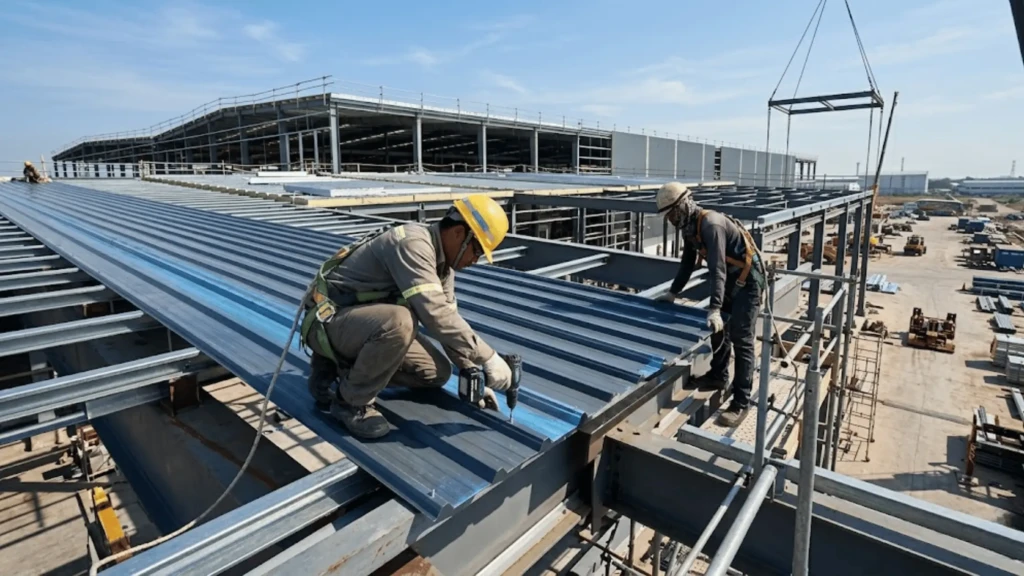
- Complete a full site risk assessment before commencement of work.
- All workers must be provided with fall-protection harnesses and PPE.
- Clear debris from the roof area and check the structural integrity of purlins and rafters.
- Check slope requirements – corrugated roof sheets require a minimum pitch of 5 degrees.
Step 2: Measuring and Planning the Layout
- Accurately measure the entire roof area, including overhangs.
- Calculate the number of sheets required, allowing a minimum of 10% extra for wastage and overlaps.
- Mark the purlin locations and sheet layout guides with chalk lines.
- Exact specifications from a qualified roofing sheets supplier in the UAE for order sheets.
Step 3: Installing Purlins and Structural Support
- Lay purlins horizontally across the rafter structure at the spacing recommended by the sheet manufacturer (usually between 1.0m and 1.5m apart).
- All structural steel shall be primed with an anti-corrosion primer before erection.
- Recheck that the frame is level and plumb before sheet fixing commences.
Step 4: Placing and Fixing the Sheets
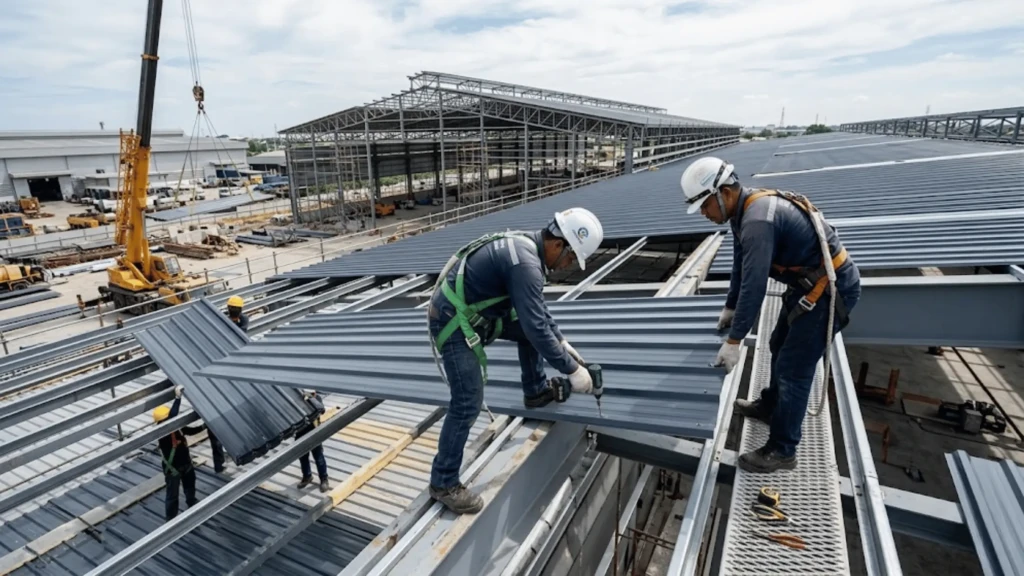
This is the essence of any method of fixing roofing sheets in industrial buildings. Follow these steps to install metal roof sheets:
- Work up from the lowest point of the roof to ensure proper water runoff.
- Place the first sheet with the correct side-lap orientation depending on the prevailing wind direction.
- For corrugated sheets, overlap adjoining sheets by at least one corrugation (minimum side overlap of 150 mm).
- For low-pitched roofs, the end-lap should be a minimum of 200mm and for steeper pitches, 150mm.
- A critical roofing sheet-fixing technique for industrial buildings to prevent water ingress at fastener points is the use of self-drilling screws with a neoprene washer.
- Screw fix at each purlin point. Normally 300mm to 500mm centres, depending on wind load requirements.
- Over-tightening fasteners crushes the washer too much, reducing its sealing ability.
Step 5: Fitting Flashings, Ridge Caps, and Gutters
- Install ridge caps at the apex of the roof, allowing a minimum 150mm lap over each side.
- Seal with butyl tape under all flashing.
- Fit eave trims and side wall flashings to prevent water entry at all roof perimeters.
- Connect downpipes and gutters to carry rainwater away from the building’s foundation.
Step 6: Final Inspection and Quality Check
- Walk the entire roof (with proper crawling boards – never walk on sheets themselves).
- Check all fastener points for proper seating and washer crush.
- Check all overlaps and flashing joints for gaps.
- Clean any metal swarf or drilling debris from the roof surface to avoid rust staining.
- Document the installation with photographs for client records and warranty.
Sourcing Quality Roof Profile Sheets in the UAE
The success of your roofing project really hinges on the quality of materials you choose. So, when you’re looking for roofing sheets suppliers or corrugated sheet suppliers in the UAE, keep an eye out for a few key factors:
- They should meet UAE and GCC building standards and obtain ESMA certification when needed.
- Make sure they provide technical datasheets and product warranties.
- Check the variety of coatings available. Galvanised, Galvalume, and PVDF paint finishes are great for desert climates.
- They should offer on-site delivery and have the option to custom-cut sheets to fit your project’s dimensions.
- Look for a solid track record in handling industrial projects of a similar scale in the UAE.
Whether you’re looking for corrugated vs standing seam for a big warehouse, standing seam panels for a distribution center, or roofing sheets for a smaller building, you’ll find plenty of reliable suppliers in the UAE.
Just remember to ask for samples and technical specs before you place any orders. And once installed, do not forget to follow some good maintenance tips for the roof profile sheets.
Types of Roof Profile Sheets to Choose From
Getting to know the different types of roof profile sheets out there can really help you pick the right material for your project. In the UAE, the most common options for industrial projects include:
- Corrugated Metal Sheets: With their classic wavy design, they offer a great strength-to-weight ratio. You can easily find these sheets from suppliers across the UAE, and they’re often among the more budget-friendly options for large industrial roofs.
- Standing Seam Panels: These panels feature raised vertical seams that interlock along the roof slope, offering great weather resistance and a sleek, modern look.
- Trapezoidal Profile Sheets: With flat tops and angled sides, these sheets are known for their impressive load-bearing capacity, making them a smart choice for long-span industrial roofing.
- Insulated Sandwich Panels: These panels feature a metal outer layer and a foam or mineral wool core, providing excellent thermal insulation and soundproofing.
- House Roofing Sheets: These are lighter-gauge options meant for smaller residential buildings or light commercial projects, and you can find them at most roofing suppliers in the UAE.
Conclusion
Choosing the right materials and following a proper installation guide for roof profile sheets are essential for ensuring durability, weather resistance, and long-term performance in industrial projects.
From planning and structural preparation to selecting suitable roofing sheet-fixing methods for industrial buildings, every step directly impacts roof lifespan and safety.
High-quality sheets, combined with expert installation, reduce maintenance costs and improve energy efficiency in demanding UAE climates.
Emirates Portacabin provides reliable roofing solutions for industrial, commercial, and modular construction projects across the UAE. The company uses high-quality materials and industry expertise to deliver strong and efficient roofing systems. Their solutions are designed to provide lasting value and long-term durability.
FAQs
What is the ideal roof slope for industrial roofing sheets?
Industrial roofing sheets usually require a minimum 5-degree roof slope for proper drainage. Steeper slopes improve water runoff and reduce the risk of leakage during heavy rainfall.
Why are neoprene washers important in roofing sheet installation?
Neoprene washers create a watertight seal around screw fasteners during installation. They effectively prevent leaks, corrosion, and water penetration in industrial roofing systems.
How often should industrial roof profile sheets be inspected?
Industrial roof profile sheets should be inspected at least twice every year. Regular inspections identify loose fasteners, rust, and flashing damage before costly repairs develop.