

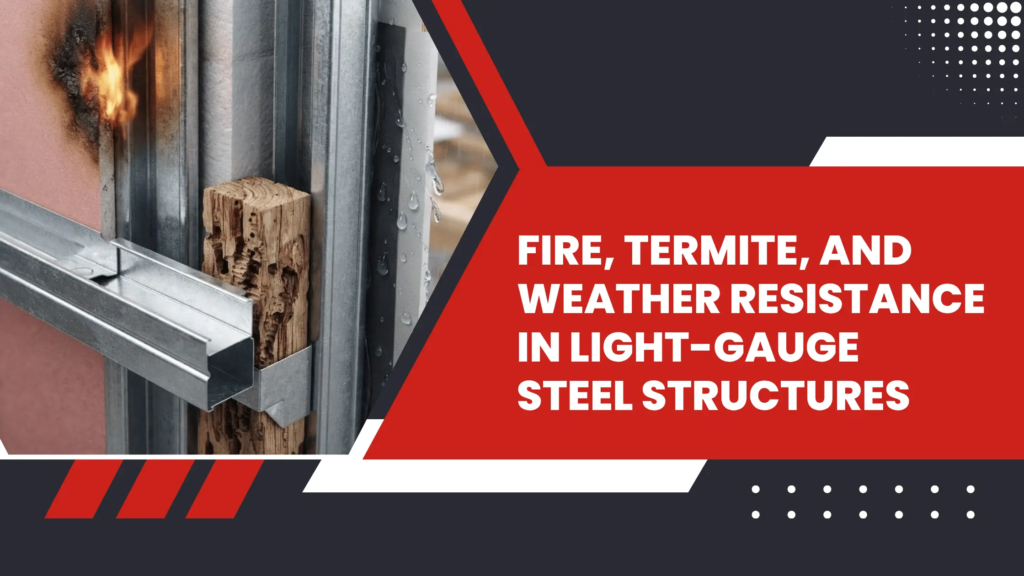
The 3 major threats that buyers of building materials in the UAE face are fire, termites, and extreme heat and humidity. Fire is one of the most addressed issues, but people often overlook that weather resistance in light-gauge steel is equally important. It applies to all buildings, like those in coastal areas with high humidity and intense sunlight.
Previously, we shared a detailed comparison of light-gauge steel vs traditional construction and explored the environmental benefits of light-gauge steel construction, including reduced material waste, efficient manufacturing, and the potential for sustainable building practices.
Today, we turn to another important consideration for building projects in the UAE: the weather-resistance properties of light-gauge steel structures.
So, some might ask, is light-gauge steel construction resistant to fire, termites, and harsh weather?
The short answer is yes.
Steel does not burn, termites cannot eat it, and galvanized steel can resist corrosion.
However, the long-term performance relies on the protective coating, fire-rated wall system, insulation, drainage, and installation quality.
How do Fire, Termites, and Extreme Weather Affect Light-Gauge Steel Structures?
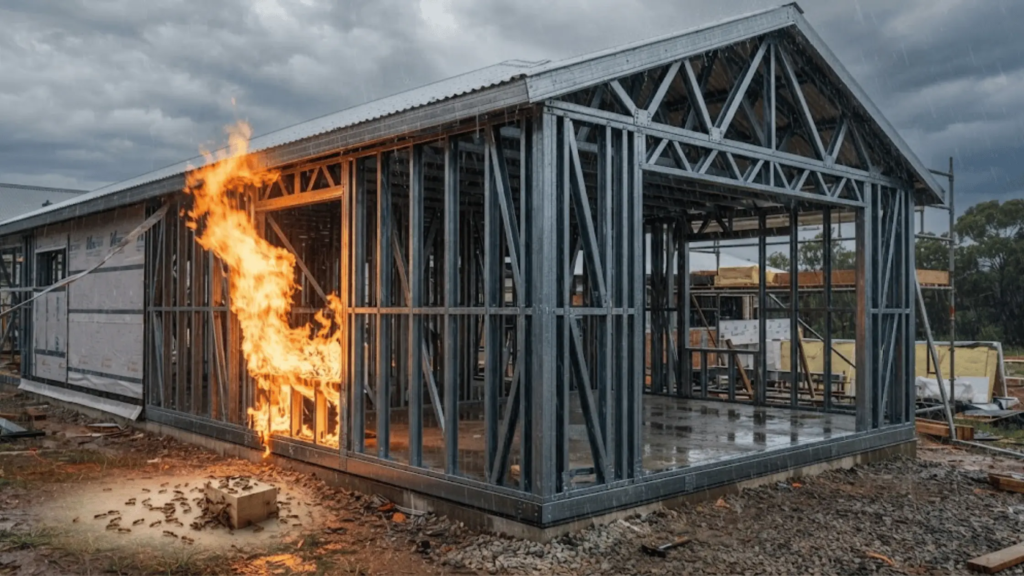
Light-gauge steel structures react differently to fire, weather, and termites. Fire can weaken steel at very high temperatures. Termites cannot eat steel but can damage other building materials. Moisture can cause corrosion if it reaches the steel through damaged coatings or poor detailing.
1. Fire Resistance
Light-gauge steel fire resistance starts with the material itself. Steel cannot burn, cannot fuel a fire, or give off smoke and toxic gases. Cold-formed steel is noncombustible in accordance with ASTM E136.
But non-combustible does not mean impervious to heat. Steel loses strength and stiffness as the temperature increases. Thin, light-gauge sections heat up quickly, and exposed steel can weaken or buckle in a severe fire.
Therefore, a building’s fire performance depends on the assembly of the entire wall, floor, or roof.
- The fire rating of the entire wall or floor assembly
- The applicable test report/certificate.
- Details of gypsum, insulation and sheathing.
- Firestopping details approved.
- Confirmation that the design meets the requirements of the local authority and civil defence.
2. Termite Resistance
It is easier to understand the light-gauge steel termite resistance. Steel is inorganic, and termites don’t feed on it. Termites can eat timber members, but they can’t eat steel studs, tracks, joists, or roof trusses.
This makes steel framing useful in warmer areas where termite activity is a concern. It also reduces the need to chemically treat the structural frame.
But a termite-resistant steel frame doesn’t make the whole building pest-proof. Termites can still attack timber doors, skirting boards, cabinets, flooring, roof elements, paper products, and other cellulosic materials.
So you need to protect against termites over the whole building, not just the framing.
Pay attention to:
- Steel structure connected to timber.
- Interior finishes, door frames, and cabinets.
- Detail of slab and ground contact.
- Service openings and hidden pathways.
- Areas that need to be inspected periodically
The obvious conclusion is that termites cannot eat the steel frame, but they can still do damage to other parts of the building.
3. Weather and Moisture Resistance
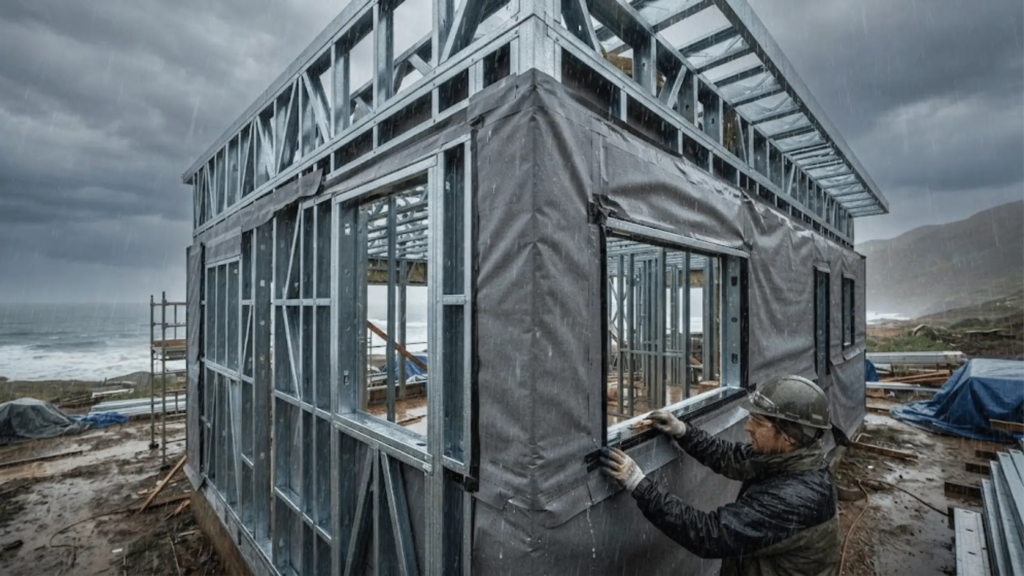
Light gauge steel weather resistance mainly comes from the zinc or metallic coating applied to the steel. The steel is durable, but corrosion can occur if the coating is damaged or unsuitable for the environment and water and oxygen are present.
The following are the benefits of hot-dip galvanizing in protecting steel:
- Barrier Protection: The zinc coating prevents moisture and oxygen from reaching the steel.
- Sacrificial Protection: If a scratch or cut exposes the base metal, nearby zinc corrodes first and protects the exposed steel.
This protection is limited. Zinc gradually wears away; service life depends on coating thickness and exposure conditions. For exterior or exposed steel, technical guidance recommends applying a suitably heavy coating, with damaged areas repaired with zinc-rich paint or another approved treatment.
Good design should contain:
- Effective waterproofing and vapour control.
- Sealed wall, roof and service openings.
- Proper drainage and flashing.
- Well insulated to avoid condensation.
- Compatible fasteners and adjacent materials.
- Protection against cut edges, scratches and drilled holes.
- A coating class appropriate for the site environment.
Galvanized steel framing can last a long time if it is installed properly and protected from constant moisture.
Industry guidance suggests that zinc-coated cold-formed steel will last the life of the building when properly installed and insulated.
Thus, the weather resistance in light-gauge steel depends on the steel itself, its coating, location, detailing, and maintenance.
How Light-Gauge Steel Buildings are Made
Light-gauge steel members are generally crafted from thin steel coils. Shaping occurs at room temperature using a roll-forming technique. This creates consistent studs, tracks, joists, trusses, and other sections.
Before forming, the steel strip is often coated for added protection, with common options including galvanized zinc and zinc-aluminum products.
After they’re finished, workers can cut, punch, label, and assemble these members into wall panels or structural frames in a controlled factory environment. This approach supports a light-gauge steel building system in which wall panels, floor systems, and roof components are prepared ahead of time before they reach the construction site.
Factory production can boost dimensional accuracy and reduce some on-site errors, but overall performance still depends on transport, connections, installation, and weatherproofing.
A modular steel building manufacturer in the UAE might take this route, creating panels in a controlled environment before transporting them to a hot, humid, or coastal location. When looking at steel structure companies in the UAE, buyers should consider asking about:
- Steel thickness and strength.
- The type and class of the coating.
- The corrosion category factored into the design.
- Fire-tested wall and floor assemblies.
- Details on insulation and thermal breaks.
- The design standards that were followed.
Installation and maintenance requirements. The term “light gauge steel manufacturers” covers a broad range of suppliers, so buyers shouldn’t focus only on price when comparing companies. The overall quality and specifications of the complete steel system matter far more than the label.
Conclusion
Light-gauge steel construction offers several benefits, including durability, faster installation, reduced material waste, and design flexibility.
The cost efficiency of light-gauge construction also makes it an attractive option for residential, commercial, modular, and industrial projects. Meanwhile, weather resistance in light-gauge steel allows properly coated and detailed structures to perform reliably in the UAE’s heat, humidity, and coastal environments.
Light-gauge steel applications range from offices and warehouses to homes, classrooms, extensions, and portacabins. Emirates Portacabin provides practical steel building solutions designed for diverse project requirements.
With proper insulation, fire protection, waterproofing, installation, and maintenance, light-gauge steel can provide dependable long-term performance.
FAQs
How long can a light-gauge steel building last?
With suitable coatings, insulation, drainage, and regular maintenance, light-gauge steel buildings can provide decades of reliable service. Proper detailing helps prevent corrosion and moisture-related damage.
Is light-gauge steel suitable for UAE conditions?
Yes, it can perform well in UAE conditions when designed for heat, humidity, coastal exposure, and condensation. Appropriate coatings, insulation, ventilation, and waterproofing remain essential.
Where can light-gauge steel construction be used?
It can be used for homes, offices, warehouses, classrooms, extensions, modular buildings, and temporary facilities. Its lightweight nature supports faster construction and flexible building designs.